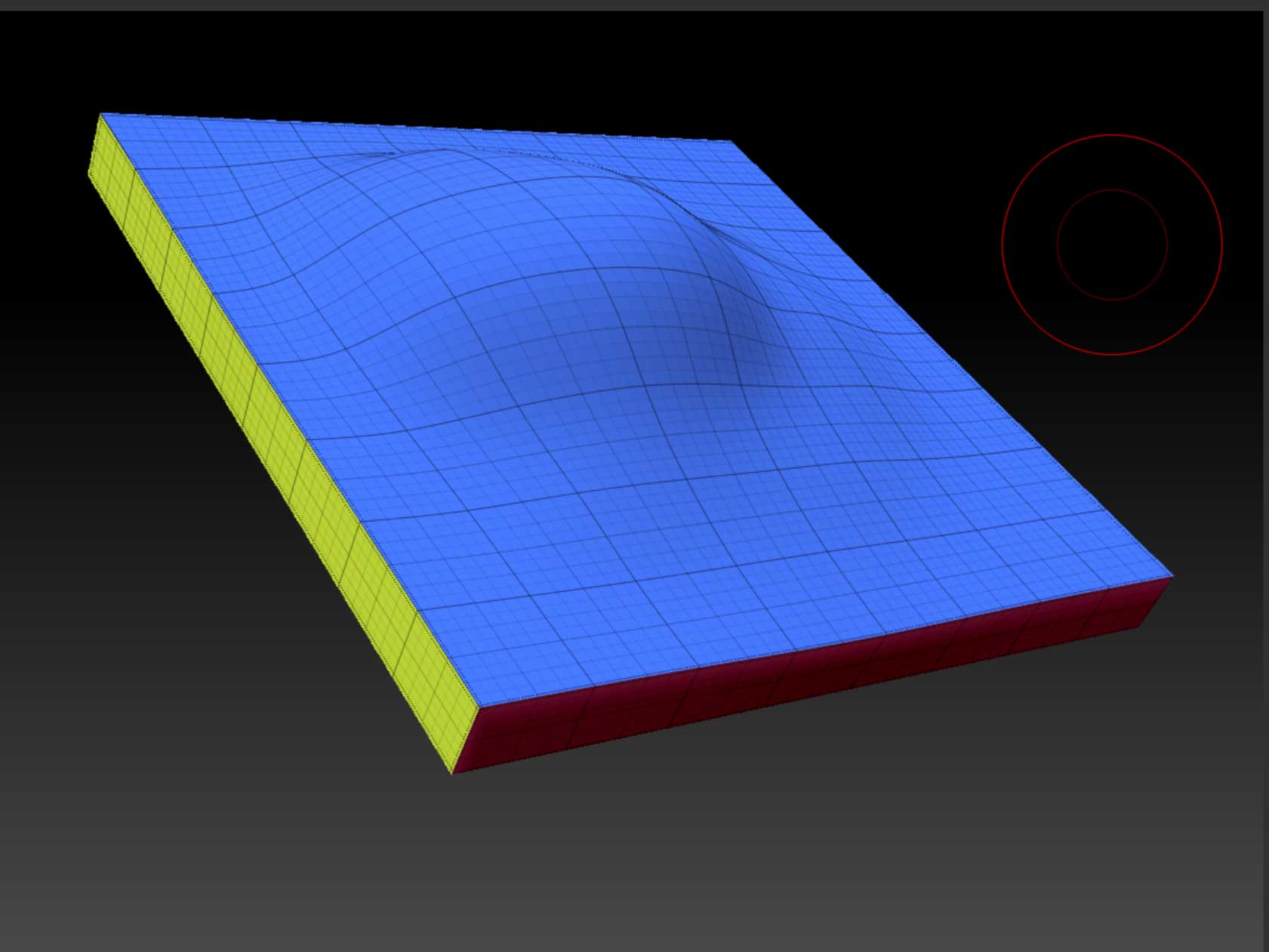
2D planar geometry has some limitations in this regard because the points on the corners are not reinforced by sufficient connecting edges.
-
Option 1 ( Outer edges creased + SMT active). The edges of the plane will stay in place but the corners will round slightly. This is because there is no reinforcing geometry to anchor the points in the corners. The degree of rounding will depend on the size of the polygons on your plane. The smaller the polygons the more the points will reinforce adjacent points, making them more resistant to smoothing.
-
Option 2 (No Creasing + SMT active). The corners will stay sharp, but the edge of the plane will shrink inward. This again depends on the density of the points on the surface. Lower poly geometry will be more heavily affected by the smoothing algorithm.
To avoid either outcome make your plane a 3D cubic solid. This adds a third anchoring “spoke” to the corner verts. Now the edges (and corners!) of that cube can be creased and will maintain both position and crisp edges, while still smoothing any non-creased edges. Extraneous geometry can be deleted after the subdivision if desired.